Wednesday, November 17, 2010

Phase Diagrams for Metal and Alloy

The mechanical properties of materials depend strongly upon microstructure and the development of microstructure of an alloy is related to the characteristics of its phase diagram. Therefore, the understanding of phase diagrams for alloy systems is very important. Phase diagram is very useful to represent the most stable relationships between phases in alloy systems. In addition, phase diagrams provide valuable information about melting, casting, crystallization, and other phenomena.

Before interpret and utilize phase diagram, it is necessary to understand component, system and phase. Components are pure metals and/or compounds of which an alloy is composed. For example, in a copper–zinc brass, the components are Cu and Zn. System may refer to a specific body of material under consideration (e.g., a ladle of molten steel). Or it may relate to the series of possible alloys consisting of the same components, but without regard to alloy composition (e.g., the iron–carbon system). Phase may be defined as a homogeneous portion of a system that has uniform physical and chemical characteristics. Every pure material is considered to be a phase; so also is every solid, liquid, and gaseous solution.

Unary System
Perhaps the simplest and easiest type of phase diagram to understand is that for a one-component system. In a one-component system, or unary system, however, the composition does not vary, but must always be unity. Therefore there are only two variables which can vary: pressure and temperature. Every possible combination of temperature and pressure can be readily represented by points on a two-dimensional diagram. Three phases (solid-, liquid, and vapor-phase) are found on this type of phase diagram.
 (www.teachersparadise.com)

Binary System
Another type of common phase diagram is that for two components or binary system. Binary phase diagrams represent the relationships between temperature and the compositions of phases at equilibrium at constant external pressure. Areas, or phase regions, are defined on these temperature-versus-composition plots within which either one or two phases exist. For an alloy of specified composition and at a known temperature, the phases present, their compositions, and relative amounts under equilibrium conditions may be determined.

Binary Systems without Solid Solution
Consider a system of two components, A and B, which are completely soluble in one another in the liquid state, but completely insoluble in one another in the solid state. The melting point of a liquid is normally depressed if the liquid contains some other substance in solution.


Binary Systems with Total Solid Solubility (Binary Isomorphous Systems)
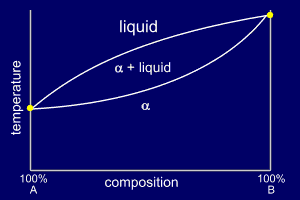
It is possible for solids to form a solution. Solid solution means that the solute component enters and becomes a part of the crystalline solvent, without altering its basic structure. Solid solutions with complete solid solubility, i.e., solid solubility over the entire range of the composition, are possible to form. For a metallic binary solution to exhibit a complete solid solubility, for instance, both metals must have the same type of crystal structure, nearly identical atomic radii and electronegativities, and similar valences because it must be possible to replace all the atoms of the initial solvent with solute atoms without causing a change in crystal structure. The copper–nickel system displays this behavior. The copper–nickel system is termed isomorphous because of this complete liquid and solid solubility of the two components. The phase diagram shapes are as shown below:

(source: www.soton.ac.uk)

Three different phase regions, or fields, appear on the diagram, an alpha (α) field, a liquid (L) field, and a two-phase field. The liquid L is a homogeneous liquid solution composed of both A and B. The α-phase is a substitutional solid solution consisting of both A and B atoms. At temperatures below about A and B are mutually soluble in each other in the solid state for all compositions.

Binary Systems with Partial Solid Solubility (Binary Eutectic System)
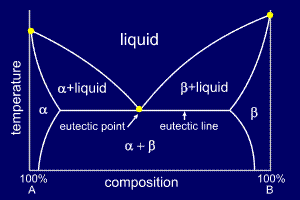
In many cases, atom size, crystal structure or other factors restrict the ease with which solute atoms can be dissolved in the solvent in the solid state. Thus it is much more common to find that solids are partly soluble in one another rather than be either completely soluble or completely insoluble. The copper–silver system displays this behavior. The following is a binary system which shows partial solid solubility:

(source: www.soton.ac.uk)

Three single-phase regions are found on the diagram: α, β, and liquid. The α-phase is a solid solution rich in A atom; it has B atom as the solute component. Otherwise in β-phase solid solution, A is the solute. Pure A and pure B are also considered to be α- and β-phases, respectively.
There are also three two-phase regions found for the system: The α+L, β+L and α+β. The α– and β-phase solid solutions coexist for all compositions and temperatures within the α+β phase field; the α+liquid and β++liquid phases also coexist in their respective phase regions.

References:
Callister, W.D. 2007. Materials science and engineering : an introduction 7ed
Lee, H.G. 2000.  Chemical Thermodynamics for Metals And Materials

Monday, November 1, 2010

Bioceramics And Their Applications

1. Hydroxyapatite (HA)
1.1. Introduction
Hydroxyapatite (HA) is a member of the apatite group of ceramics. The term “apatite” is derived from the Greek apatê, which means deceit or deception. It was called such for its diversity of form and color.
1.2. Source
There are two sources of apatite: one biological and the other from mineral deposits, such as phosphate rock or phosphorite, a sedimentary rock the essential mineral components of which is carbonate fluoroapatite. Bone and teeth contain a HA-like mineral component that supports the majority of load in vivo. Deorganized bone and some sea corals (porites) are used to make implants.

1.3. Properties
The (bio)chemical and mechanical properties of HA are similar to those of bone and teeth. Their molecular structures are also similar, although the exact nature of the composite, the minerals and proteins, and their interactions are not fully understood.
1.3.1. Mechanical Properties
There is a wide variation in the reported mechanical properties of HA. Jarcho2)reported that fully densified polycrystalline specimens of HA synthesized by themhad average compressive and tensile strengths of 917 and 196 MPa, respectively.Kato2) noted a compressive strength of 3000 kg/cm2 (294 MPa), a bending strength of1500 kg/cm2 (147 MPa), and a Vickers hardness of 350 kg/mm2 (3.43 GPa).
1.3.2. Chemical Properties
Hydroxyapatite is considered bioactive, indicating that the ceramic may undergo ionization in vivo and that the rate of dissolution may depend on many factors — includeing degree of crystallinity, crystallite size, processing condition (temperature,pressure, and partial water pressure), and porosity. Hydroxyapatite is soluble in anacidic solution while insoluble in an alkaline one and slightly soluble in distilled water. The solubility of sintered HA is very low. The rate of solubility is 0.1 mg/yearin subcutaneous tissue. Hydroxyapatite reacts actively with proteins, lipids, and otherinorganic and organic species.
1.3.3. Biological properties
1.3.3.1. In vitro cell response

Substituted HA or HAP showed the following cell response: (a) carbonate-substituted apatite stimulate greater activity of osteoclasts compared with carbonate-free HAP or FAP or F-treated dentin (b) stimulation of proliferation and phenotypic expression of F-containing HAP or Ftreated bovine bone (c) difference in response between odontoblasts and osteoblasts
1.3.3.2. Tissue response
HA have bioactivity proerties, ability of the material to directly ‘bond’ to bone through chemical interaction and not physical or mechanical attachment. HA also have osteoconductive properties – an ability to serve as a scaffold or template to guide the newly forming bone along its surfaces.
1.4. Applications
1.4.1. HA as abrasive
HA or apatitic abrasive (biphasic calcium phosphate) has gained popularity as the abrasive of choice for orthopedic and dental implant. Implant surface gritblasted with HA or apatitic abrasive was shown to be cleaner (free of inclusions) compared with alumina [31] and appear to promote higher bone contact.
1.4.2. Bone graft materials and scaffolds
Dental applications of HA materials include: implants as immediate tooth root replacement, alveolar ridge augmentation , pulp capping , periodontal defects, bone regeneration with guided tissue regeneration membrane ; alveolar distraction osteogenesis, peri-implantitis defects, reconstruction of severely atrophic human maxillae and sinus lifts. Medical applications include: repair of bone defects, chin augmentation, ear implant by itself, or as a composite with high molecular weight polyethylene, spine cage, tibial osteotomy in patients with osteoarthritis, and as a percutanous device. HA or HAP is also used as component of calcium phosphate cement, CPC .
1.4.3. Implant coatings
In spite of the many good qualities of HA and related calcium phosphates (e.g. B-TCP) such as bioactivity and osteoconductivity, they cannot be used in load-bearing areas because of their low fracture strength. On the other hand, metal implants, primarily titanium (Ti) or Ti alloy, are not bioactive and therefore do not bond directly to bone.
1.4.4. Drug delivery and other applications
HA ceramic is used as gene carrier or transfection agents , for drug delivery such as delivery of anticancer drugs or bisphosphonate, or as scaffolds for bone regeneration by tissue engineering.

2. Tricalcium Phosphate (TCP)

2.1. Introduction
The term biphasic calcium phosphate (BCP) was first used by Ellinger et al. to describe the bioceramic previously described as ‘tricalcium phosphate’ but was shown by LeGeros in 1986 using X-ray diffraction (XRD) to consist of a mixture of 80% HA and 20% B-TCP.
2.2. Fabrication
Biphasic calcium phosphate (BCP), or intimate mixtures of HA and B-TCP, is obtained when synthetic calcium-deficient apatites (CDAs) are sintered above 900 °C [11,26,29] according to the following reaction:
2.3. Properties
2.3.1. Physicochemical properties
Since B-TCP has a higher solubility than HA, the extent of dissolution of BCP ceramic of comparable macroporosity and particle size will depend on the HA/B-TCP ratio: the higher the ratio, the lower the extent of dissolution. This phenomenon may be caused by processing variables (sintering time and temperature).
2.3.2. Mechanical properties
BCP ceramic prepared from a single calcium-deficient apatite phase was reported to exhibit higher compressive strength (2–12 MPa) compared with BCP ceramic prepared by mixing two unsintered calcium phosphate preparations (2 MPa): one that after sintering at 1200 °C resulted in only HA and the other that resulted in only B-TCP [48]. The initial mechanical property is not the best criterion for efficacy of bone ingrowth.
2.3.3. Bioactivity and osteogenic properties
Bioceramics (calcium phosphates, bioactive glass) do not usually have osteoinductive property. However, several reports indicated osteoinductive properties of some calcium phosphate bioceramics such as those reported for coralline HA (derived from coral) or observed in some studies using BCP.
2.4. Applications
2.4.1. Applications in dentistry
Dental applications of BCP include prevention of bone loss after tooth extraction, repair of periodontal defects and sinus lift augmentation.
2.4.2. Applications in orthopedics
Micromacroporous biphasic calcium phosphate bioceramics are largely used in orthopedics and effi cacy has been demonstrated in numerous preclinical and clinical studies, for example using specific shaped blocks (custom-designed) for spine arthrodesis (cage insert) and wedges for tibial valgization osteotomy of valgization.

3. Alumina (Al2O3)
3.1. Introduction

Aluminium oxide (Al2O3), more commonly known as alumina, is the most widely used oxide ceramic material. Bauxite (hydrated aluminum oxide) and native corundum (aluminum oxide mineral) are the main sources of high-purity alumina. As a raw material, Al2O3 powder is produced in large quantities from the mineral bauxite, by the Bayer process. Bayer process, which yields D-alumina. The Bayer process involves dissolution of crushed bauxite in sodium hydroxide (NaOH) solution under pressure at high temperatures (up to 300ºC) to form a supersaturated sodium aluminate solution.
3.2. Properties
3.2.1. Physical properties

Additives or impurities determine the colour of alumina, in addition to the sintering atmosphere, and by the interaction with ionising radiation. Alumina is generally white but can sometimes be pink (88% alumina) or brown (96% alumina). When chromium oxide (Cr2O3) is added, it reacts with Al2O3 to form a solid solution. The amount of chromium oxide added will determine whether the colour of alumina changes to pink or ruby. When medical-grade alumina is sintered in air together with the addition of magnesia, it will appear as ivory. Alumina turns white when it is sintered in reducing atmosphere or if it contains traces of silica.
3.2.2. Mechanical properties
Because of their strong bonding, alumina ceramics have very high melting or, more appropriately, dissociation temperatures, hence the production of alumina ceramics can only be achieved with high-temperature sintering. During the sintering process, powders are heated usually to two-thirds of their melting temperature. As shown earlier, during this densification particles bond together to form necks between the particles, which subsequently reduce the surface area and cause the powder to consolidate.
3.3. Applications
High-purity alumina bioceramics have been developed as an alternative to surgical metal alloys for total hip prosthesis and tooth implants. Their high hardness, low friction coefficient and the excellent corrosion resistance of alumina offer a very low wear rate at the articulating surfaces in orthopaedic applications. Alumina has the ability to be polished to a high surface finish. Other applications for alumina in orthopaedic and maxillofacial applications include porous coatings for femoral stems, alumina spacers employed specifically in revision surgery (Huckstep and Sherry, 1996), knee prostheses (see Fig. 10.4), and in the past as polycrystalline and single crystal forms in dental applications as tooth implants.

4. Zirconia (ZrO2)
4.1. Introduction

Zirconium oxides (zirconia) have been used for the purpose of fabricating implants. Some are called “fake diamond” or “cubic zirconia” since some zirconia single crystals can be of gem grade and made into jewels. Some of their mechanical properties are as good or better than those of alumina ceramics. They are highly biocompatible, like other ceramics, and can be made into such large implants as the femoral head of a hip joint replacement. Some of their drawbacks include the fact that they exhibit high density, low hardness, and phase transformations under stress in aqueous conditions, thus degrading their mechanical properties.
4.2. Source
Zircon (ZrSiO4) is the most commercially important zirconium mineral and is found mostly in the mineral baddeleyite. Zircon is a gold-colored silicate of zirconium, a mineral found in igneous and sedimentary rock and occurring in tetragonal crystals colored of many colors. The transparent varieties are usually deposited in beach sand, and are used as gems. Zircon is first chlorinated to form ZrCl4 in a fluidized bed reactor in the presence of petroleum coke. A second chlorination is required for highquality zirconium. Zirconium is precipitated with either hydroxides or sulfates, and then calcined to its oxide.
4.3. Properties
4.3.1. Physical Properties

Zirconia undergoes an allotropic phase transition from monoclinic to tetragonal at 1000~1200ºC, and from tetragonal to cubic at 2370ºC. The cubic-to-monoclinic and tetragonal
phase transition is diffusionless and accompanies a volume expansion of about 7%. The cubic structure of zirconia belongs to the group of fluorite (CaF2) structures.
4.3.2. Mechanical properties
The strength of the partially stabilized zirconia with yttrium oxide (Y–TZP) showed the highest flexural strength and fracture toughness. However, the Weibull modulus was lower than the yttrium magnesium oxide-stabilized zirconia (Y–Mg–PSZ). It is also interesting that the increased fracture toughness is due to a phase transformation caused by cessation of crack propagation.
4.4. Applications
Yttrium-stabilized zirconia has been used to fabricate the femoral head of total hip joint prostheses and has two advantages over alumina. One is the finer grain size and well-controlled microstructure with minimum residual porosity, resulting in a better tribological material than with alumina. The other is higher fracture strength and toughness due to the phase transformation toughening process. Approximately 20% of the prosthetic femoral heads manufactured in the world are made of ceramic, with a strongly growing market (i.e. more than 25% growth for the alumina–alumina coupling between 2002 and 2004). Up to the year 2000,approximately 40% of ceramic heads were zirconia and the remaining alumina.

5. Reference:
1) Kokubo, Tadashi. Bioceramics and their clinical applications. England : Woodhead Publishing.
2) Park, Joon. 2008. Bioceramics - Properties, Characterizations, and Applications. USA : Springer.

Solder Bebas Timbal

Solder merupakan paduan logam yang digunakan untuk menggabungkan dua atau lebih komponen. Komponen yang disatukan itu bisa berupa logam atau paduan logam lain. Solder digunakan secara ekstensif pada industri elektronik untuk menyatukan komponen secara fisik agar dapat menghantarkan sinyal listrik.

Solder bekerja dengan meleleh oleh adanya panas. Lelehan solder kemudian mengalir dan membuat kontak dengan komponen yang akan bergabung (yang tidak meleleh). Setelah pembekuan, solder membentuk ikatan fisik dengan semua komponen.

Sebelumnya, solder terbuat dari paduan Pb-Sn. Paduan ini murah dan mempunyai titik leleh rendah sehingga memungkinkan bekerja pada suhu dibawah titik leleh komponen yang akan disatukan. Solder Pb-Sn mempunyai komposisi 63 wt% Sn-37 wt % Pb. Menurut diagram fasa Pb-Sn, komposisi ini dekat dengan titik eutektik dan mempunyai temperatur leleh sekitar 183 oC. Temperatur ini adalah temperatur paling rendah yang bisa dicapai dengan keberadaan fasa liquid. Paduan ini kemudian dikenal sebagai solder Pb-Sn eutektik.

Namun sayangnya, timbal merupakan logam toksik dan mempunyai dampak lingkungan yang serius apabila lepas ke air tanah dari landfill atau ke udara jika masuk ke incinerator. Akibatnya, beberapa negara telah membatasi penggunaan timbal ini. Hal ini mendorong pengembangan solder bebas timbal yang masih mempunyai temperatur leleh rendah. Beberapa diantaranya adalah paduan terner (tersusun atas tiga logam) solder timah-perak-tembaga dan timah-perak-bismut. Komposisi beberapa solder bebas timbal disajikan pada tabel berikut.


Ada beberapa kesulitan menggunakan solder bebas timbal. Pertama adalah rendahnya rendahnya kemampuan alir dari solder sehingga kemampuan solder untuk menyatukan komponen secara elektrik berkurang. Kemampuan alir ini diketahui tidak dapat ditingkatkan dengan peningkatan temperatur. Kesulitan kedua adalah tingginya titik leleh. Secara umum titik leleh solder bebas timbal adalah 20 hingga 45 oC lebih tinggi daripada solder konvensional. Akibat dari temperatur tinggi adalah berkurangnya umur tip solder karena oksidasi atau erosi, karbonasi pada solder, dan percikan api. Penggunakan solder bebas timbal dikatakan dapat mengurangi umur tip hingga 4 kali.

Friday, October 29, 2010

Innovation Towards Sustainable Materials-Just what the Doctor ordered: meet the People, the Global Movers.

Big names, concerned scietists, engineers and business executives meet to work on what many consider to be millenium class issues- To Be Treated Fittingly on WWI & II rememberance, Amnesty Day 11-11 1945.   


Big meeting - constructive thinking for serious future planning  anticipated and expected from such a panel of experienced, highly professional specialist in their respective fields.


In all 10 sub-themes will be treated in this expert's approach to Sustainable Materials, Innovation.


1:Setting the Global Scene are: Start 10 Nov. 2010.

• Ian Christmas (Director General, World Steel Association)

• Per Sandberg (Director, International Projects, WBCSD)

• Peter Bonfield (Chief Executive, Building Research Establishment)


2:Materials Sourcing, Processing Technologies, Extractive Industries


• John Groom (Safety and Sustainable Development Adviser, Anglo American)

• Craig White (Wood Technology, White Design)

• Sevket Durucan (Professor of Mining and Environmental Engineering, Imperial College)

• James Anderson (Director of Sustainability, AMEC)

3:Construction and the Built Environment contributions from:

• Hank Dittmar (Chief Executive, Prince's Foundation, Built Environment)

• Beulah Keane (Project Manager, Marks and Spencer, Plan A; Sustainable Construction

• Jamie Smith (Skanska)

• Javed Sethi (Marketing Manager, Lafarge Cement UK)

4:ResourcEfficiency and Environmental Technologies


• Carolyn Roberts (Director, Environmental Sustainability KTN)

• Richard Swannell (Director, WRAP)

• Theo Lehner (Manager, Business Development, Bolidien)

• Edward Way (Chairman, Green Power Limited

5:Assessment Tools and Information Management

• Mike Ashby (Director, Granta Design)

• Rana Pant (European Platform on Life Cycle Assessment, European Commission)

• Norman Swindells (Managing Director, Ferroday Ltd)

• Angela Druckman (Senior Lecturer in Sustainable Energy and Climate Change Mitigation,

Surrey University)

Guest Speaker: Tom Heap (Presenter, Costing the Earth, BBC Radio 4

Thursday 11th of  November

6: Setting the Forward Strategy

• Head of Climate Change, Tata Group
7: Product Design, Packaging and the Consumer

• Martin Charter (Director, Centre for Sustainable Design)

• Tony Taylor (Sustainability and Packaging Manager, Unilever UK)

• Stuart Patrick (Chairman, The Polymer Society, The Institute of Materials, Minerals

and Mining)

8: Transport and Infrastructure.

• Robin Haycock (Transport Energy Consultant, Arup)

• George Coates (Project Director, WorldAutoSteel)

• Geoff Scamans (Chief Scientific Officer, Innoval Limited)

• Pat Winfield (Senior Research Fellow and Deputy Head of Sustainable Vehicle

Engineering Centre, Oxford Brookes University)

9: Energy and Climate Change.

• Rosemary Albinson (Technology and Transport Strategy Advisor, BP Castrol)

• Markys Cain (Knowledge Leader, Functional Materials Team, NPL)

• Rod Martin (Chairman, British Composites Society, IOM3 and Chief Execuitve, MERL)

10: Sustainable Manufacturing and Processes

• Mike Gregory, CBE (Head of Manufacturing and Management Division, Institute for

Manufacturing, University of Cambridge)

• Pascal Payet-Gaspard (Secretary General, International Stainless Steel Forum

Closing Address

• Roland Clift, CBE (Distinguished Professor of Environmental Technology, Surrey

University)

 
More information...? 
cf.  Institute of  Materials Minerals and Mining, IOM3, the global network for the full materials cycle

Tuesday, October 26, 2010

People working in the field of High Temperature Wear and Erosion - Meeting in Derby famous Engineering City Home of Rolls Royce Aero Engines


High Temperature Wear and Erosion
The People, The Subjects Covered, The Places where things happen 10 November 2010, Riverside Centre, Derby
Register Now


The programme features presentations on:

  • Introduction to high temperature materials, with particular reference to their microstructure
    Professor Sarah Hainsworth, University of Leicester

  • Multilayer coatings for erosion protection: Design, modelling and erosion testing
    Dr Richard Wellman, Cranfield University

  • CFD modelling of particle erosion in high temperature corrosive environments
    Professor Margaret Stack, University of Strathclyde

  • High temperature tribological testing
    Dr Mark Gee, NPL

  • Challenges in the quantification of high temperature erosive wear
    S. Graça, M. Hadad, P. Hoffmann, H. Du, EMPA and Alstom Power Ltd

  • High temperature wear and friction performance in a steam environment for power generation sealing applications
    Dr Louise Brown, NPL

  • Recent approaches to developing and understanding nano-structured coatings which might have a future in high temperature wear and erosionapplications
    Professor Allan Matthews, University of Sheffield

  • The design of present and future surface coatings to resist erosion and wear in aero turbines
    Dr David S Rickerby, Rolls-Royce, Derby
The fee to attend the conference is just £98.00 plus VAT for IOM3 Members (or £134.00 plus VAT for non-members).


More Information
Melanie Boyce
Conference Manager
The Institute of Materials, Minerals and Mining

1 Carlton House Terrace, London SW1Y 5DB, UK


More information contact  Institute of Materials, Minerals and Mining (IOM3)

Thursday, October 14, 2010

Beyond the price of copper and gold. Trapped Chilian Cu and Au miners safe in spectacular rescue

This good news follows a spate of tragic outcomes for the World's mining communities, from China through Central and Eastern Europe.(The Chile Cu and Au mine collapsed on 5th Aug 2010.)

So after the euphoria,of this resounding success by Chile and the International Community this remains a dire warning to the World's mining community of the continuing effort necessary to ensure proper, civilised -mane safety regulations and measures in practice.

1st Encouraging News
August 23, 2010 · Posted in News
"Deep copper and Gold mine Accident, 33 Miners Survive after 17 days Trapped in." (cf Ref below)

"Copiapo, Chile – When 33 men found alive after 17 days trapped in a deep copper and gold mine, the biggest challenge now, the preservation of their mental health in the months can take to cut a tunnel large enough for them to get out .
Chileans were euphoric Sunday after a small drill bit broke through 2257 feet (688 meters) of solid rock in an emergency refuge where the miners had gathered to reach. The men are soon connected two notes at the end of a probe that rescuers pulled to the surface, announcing in large red letters: “All 33 of us are fine in the asylum.”
“Today all of Chile is crying with excitement and joy,” said Sebastian Pinera President in the mine.

Mine officials and relatives of the workers had hoped that the men reached a shelter under the place where the tunnel collapsed August 5 at the San Jose gold and copper mine about 530 miles (850 kilometers) north of the capital Santiago. But she said the reception in case of emergency air and food supplies would last only 48 hours.

The miners seemed to understand that their salvation may be slow, according to one of them, Mario Gomez, perhaps the oldest of the 63 trapped men, who wrote a letter to his wife.


Gomez said that the miners used for light vehicles and an excavator to dig a channel for water to get underground.

It was unclear whether the air threatened to walk.

Rescuers had drilled repeatedly in an attempt to reach the shelter, but failed seven times. They blamed the errors on the maps of the mining company. According to a note from Gomez, at least some of the earlier probes were close enough that the trapped miners heard them. The eighth attempt finally succeeded.

Gomez noted that the President read aloud on live television, focusing on expressions of faith and love for his family. But through frustration showed in a line, where he declared that “this company has to modernize.”
Chile is the world’s top copper producer and a leading producer of gold, and has some of the most advanced in the world mining. But both the company that the mine, San Esteban and the National Mining and Geology Service held criticized for allegedly not complying with regulations. In 2007, an explosion at the San Jose mine killed three workers."
REFERENCE 1.

Excellent News
Chile Mine Rescue, 32 of 33 miners were above ground after trapped deep underground for 69 days
October 14, 2010 · Posted in News · Comment


SAN JOSE MINE, Chile miners who were trapped deep underground for 69 days were drawn to the rescue for a Wednesday in a process that was faster than expected and people around the world was transfixed.
The miners rose to the surface in a red, white and blue rescue capsule called “The Phoenix”. By Wednesday noon, 32 of the 33 miners were above ground. As they came to the Chilean newspaper websites of keeping a running score, almost like a sporting event. “Things have gone extraordinarily well so far.

REFERENCE 2

We now know all have been rescued. The spectacular rescue has been the Global Event of The Week, for it's length, it's difficulty, and the courage of the miners, for the attitude of all invoved.

#comment-form#comment-form

#comment-form#comment-form

& A cheaky Bioplastic link
Bioplastic link